Tick-borne red meat allergy sees increased presence | State
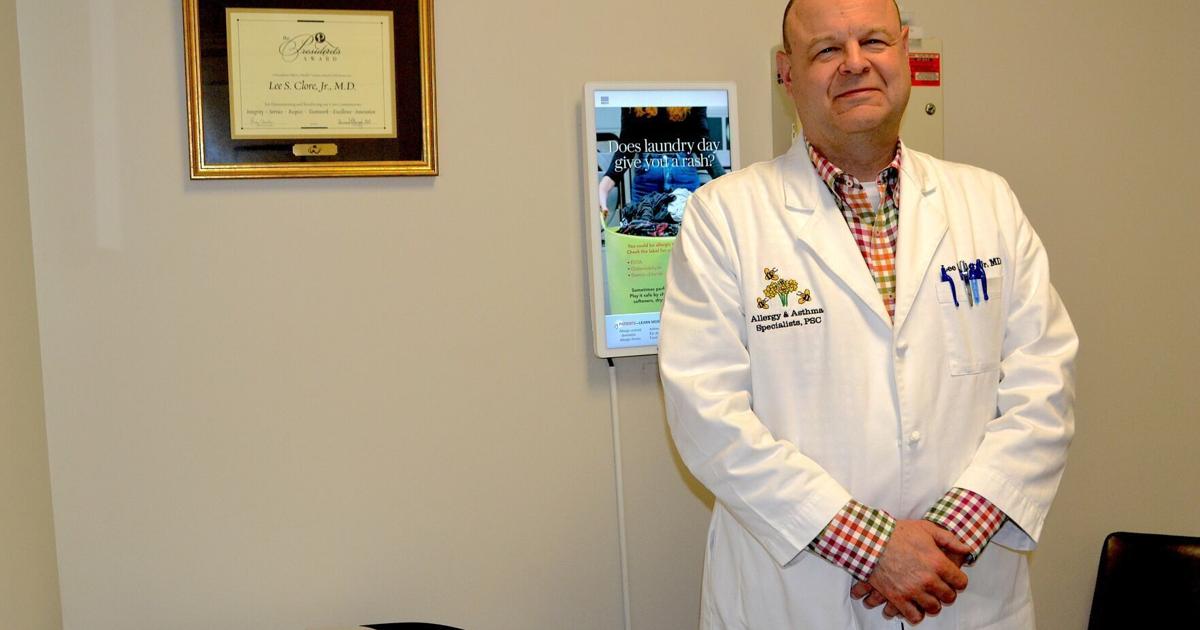

Dr. Lee S. Clore Jr. of Allergy & Asthma Specialists, PSC, is considered among the national experts on alpha-gal syndrome, which is a tick-borne illness that causes allergic reactions in humans who eat red meat.
Dr. Lee S. Clore Jr., who specializes in allergy immunology at Allergy & Asthma Specialists, PSC, has been practicing in Owensboro and Daviess County for more than 20 years.
Though when Clore was starting out, “there was no such thing” as alpha-gal syndrome.
“We would see patients that had allergic reactions to beef and to pork, but we didn’t know that they were related,” Clore said.
In 2009, Clore’s friend and colleague Dr. Scott P. Commins, current associate chief of allergy & immunology and research with the University of North Carolina at Chapel Hill’s School of Medicine, conducted a research project while Commins was in his fellowship program at the University of Virginia that involved looking at deer hunters “that had some funny reactions” after consuming deer that had been killed, field dressed and processed.
Commins’ initial findings found tick bites, specifically deriving from the lone star tick, to be the cause of said reactions.
“We saw him present that paper in 2010,” Clore said, who witnessed Commins detail his research during a Southeastern Allergy, Asthma and Immunology Society meeting, “… and after I introduced him, I went to the back of the room telling my colleagues, ‘Gosh, I hope we never see this. This sounds terrible.’”
Alpha-gal syndrome (AGS), as described by the U.S. Centers of Disease Control and Prevention as a “serious, potentially life-threatening allergy and tick-borne disease,” occurs when a tick transfers its alpha-gal molecule (galactose-α-1,3-galactose) from its saliva into a person’s blood, causing one to develop an allergic reaction after eating red meat.
“Through the early research of Dr. Commins and others have done, we’ve discovered that in the southeastern United States is where this is pretty prevalent, … and (the) lone star tick seems to be the vector that’s most commonly thought to cause or to be involved with alpha-gal syndrome,” Clore said. “Susceptible individuals will get a tick bite — even from the infant tick that looks like a chigger … — and one to three months later, you start having funny reactions.
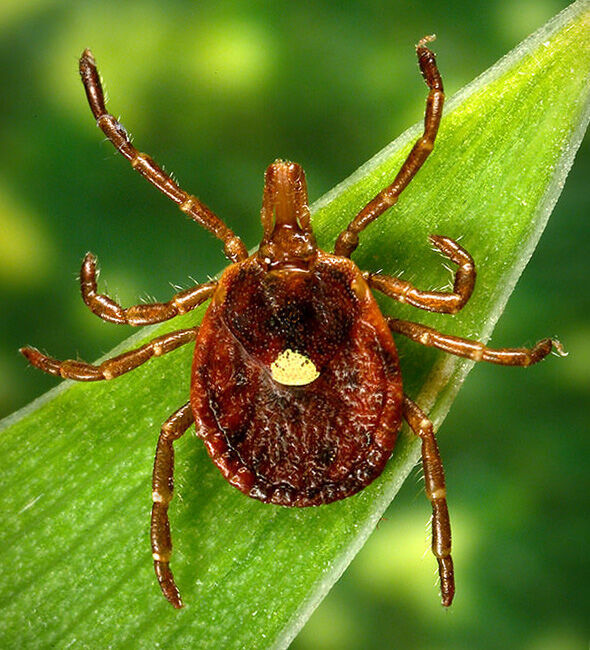
The lone star tick has been linked to the growing number of case involving alpha-gal syndrome, a tick-bite-induced allergy to a sugar molecule (alpha-gal) that is found in red meat and other mammalian products that causes delayed reactions including abdominal pain, hives and anaphylaxis.
“The tick bite itself leads to an allergy being developed in the human subject to this (galactose-α-1,3-galactose) sugar that is found in mammals except for gorillas and humans,” Clore continued, who mentioned reactions can range from abdominal pain, hives and itching up to trouble breathing and anaphylaxis. “… The sugar itself … is found in every inch of the mammals …, and the biggest concentration is in the meats.”
Within a couple years following Commins’ initial findings, Clore started seeing more cases as the awareness, information and research about the allergy became more available.
In 2023, the CDC reported Kentucky as one of the “hot spots” of suspected cases of the tick-borne allergy alongside states such as Arkansas, Indiana, Missouri, Mississippi, North Carolina and Tennessee, among others.
“By 2013 or 2014, we were seeing three or four a day,” Clore said, “and I still see probably three or four new patients a day with alpha-gal syndrome.
“And that’s not the return patients — that’s the new patients,” Clore continued. “If you add the return patients, I probably see eight or 10 a day sometimes.
“Some estimates now are around half a million people in the United States,” Clore said of those that have now been diagnosed.
Additionally, Clore said around 80 to 90% of AGS patients can tolerate dairy, while “a really small percentage” have reactions to gelatin — the latter commonly deriving from collagen found in animal body parts.
AGS is also characterized by its delayed reactions, with symptoms appearing between two to six hours after consumption of a product containing the sugar molecule, according to Mayo Clinic.
In November, a case study from the Journal of Allergy and Clinical Immunology in Practice reported a 47-year-old male from New Jersey to be confirmed as the first fatality linked to AGS.
“In the subsequent autopsy, there were huge allergy markers that confirmed that was the cause of death,” Clore said. “… I’d never seen a case here that led to fatality. Most of the cases are mild to moderate, but I’ve had people in the hospital. I’ve had people in the emergency room. I’ve had people use their EpiPens. But all of them have left and (have) done well.”
Clay Horton, public health director for the Green River District Health Department, said AGS is “not a nationally-notifiable” allergy, though some states — including Kentucky, as of earlier this year — have made it reportable and are “taking an active role in tracking it” albeit with limitations.
“At this point, I don’t know if we have enough data to make sense of it all, but the process has started,” Horton said. “(In) talking with our epidemiologist, the number of reports that they have gotten have been pretty significant.
“… There’s a lot of work involved in trying to sort through those lab reports to determine if these are new cases, or are these people who’ve had this condition for some time and are just following up with additional lab work or is it something that were to count as a case definition,” Horton said. “The way the process works (is) one individual (that is) seen has a blood test, the laboratory that conducts the blood test will report that, and then one of our epidemiologists or disease investigators will follow up with the patient, administer a questionnaire and then try to determine if this is alpha-gal syndrome ….”
As of Monday, Horton said 424 patients have been reported for AGS throughout its seven-county coverage area, with a majority being from Daviess County, though Horton feels it’s too early to tell in the process to know of AGS’ potential trajectory as investigating the allergy is still in the preliminary stages.
“We track all kinds of reportable conditions, so doing investigations is not that new,” Horton said. “But I do think that you have to collect enough data over a significant period of time before you can kind of develop a trend or a picture of what’s really happening in the community.
“I think it has increased since it’s become reportable, but it’s still probably too early to say what the overall trend would be,” Horton said.
While there is no confirmed cure or vaccine for AGS, Clore said some treatment options have been explored and utilized such as Xolair (omalizumab), which is commonly used to treat asthma, in advanced cases after it was approved by the Food and Drug Administration in February 2024 as a preventative medicine for food allergies.
“… Severe cases of alpha-gal will be on omalizumab to prevent those bad episodes if they have an accidental exposure,” Clore said. “… You (also) have an EpiPen that (could) be in your pocket, should you ever have an allergic reaction ….”
Though Clore said there is a chance AGS can eventually subside all together.
“About six to seven times out of 10 over time, with strict avoidance, it fades away,” he said. “… With most patients when it goes away, it stays away; maybe 10% of them have it recur.”
While AGS patients have sought out acupuncture as a treatment option, its results have varied per individual.
“The acupuncture’s been going on for six (to) eight years now (but) there’s no research to support that acupuncture will do anything here,” Clore said. “It won’t hurt you, but it won’t cure your alpha-gal.”
Nevertheless, those diagnosed with AGS are typically required to make lifestyle changes — especially regarding diet and dining out.
“Most patients rarely have subsequent events at home, so when you go out to dinner it’s hard because of cross-contamination (potential),” Clore said of the latter point, who recommends asking restaurant staff to see if accommodations or modifications can be made by request.
Regarding prevention, CDC recommends the use of Environmental Protection Agencies-registered repellents that include DEET, picaridin, IR3535, oil of lemon eucalyptus (OLE), para-menthane-diol (PMD) or 2-undecanone; wear clothing and gear treated with 0.5% permethrin; and shower and check body for ticks upon coming indoors.
“It’s all the things that we talk about in the summer time when you’re going to be out in the woods or in areas where there’s a lot of wildlife,” Horton added.
While there are still uncertainties and additional research being conducted on AGS, Clore finds cases will continue to increase though he does not feel all hope is lost.
“… As long as it keeps getting warm across this part of the globe and you have ticks that live all year-round and (potentially) other insect vectors …, I think the exposure is going to be greater and greater,” he said. “… I would say if you get diagnosed with alpha-gal syndrome, it is frustrating because you’re used to eating these meats and a lot of (us tend) to enjoy them; but strict avoidance of the meats is very effective, and at six to seven times out of 10 doing that, it may go away.
“We also have medicines to use to prevent severe reactions. We have medicines used to treat severe reactions if they occur, which is very reassuring,” Clore said. “… Even though there’s not a vaccine in development, we might see in the grocery stores — in the not-so-distant future — alpha-gal free pork, for instance, so we’re making it easier for these folks to shop.
“I think there’s a lot to be hopeful for and about,” Clore said.
link