Everything to know ear seeds, from its health benefits to its risks
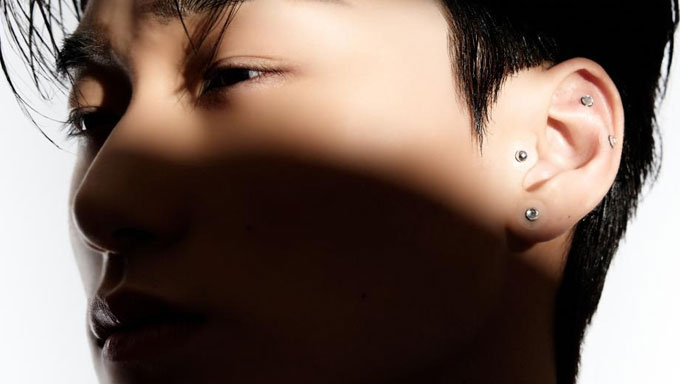
This year, the term ear stack takes on a whole new meaning. Or at least it does in the beauty sphere, thanks to the roll-out of a nifty new apparatus in our favourite drugstores and online platforms. Dubbed ear seeds, it’s likely you have spotted these patches on your favourite idols—Seventeen’s Kim Mingyu and Ateez’s Choi San are advocates—with the most popular mass iteration resembling crystal studs. Worn in multiples and along different sections of the ear, these mass-market variants are undoubtedly recent entrants into the wellness space. The concept of ear acupuncture, however, is far from novel.
“Ear seeds are tiny beads you can wear daily that are often made from magnets, gold, or a herb called Wang Bu Liu Xing,” elaborates Jun Negoro, TCM physician from Thomson Chinese Medicine. “They are placed in particular points of your ear to gently guide your body back in balance. You see, in auriculotherapy, the ear is viewed as a microsystem of the whole body, and it is shaped like an upside-down baby—the head is near the earlobe, the spine along the curve, and the legs are at the top. Each acupuncture point, thus, corresponds to an organ or body part, so stimulating it can have whole-body effects.”
This, naturally, raises the question: what can ear seeds do for your health and body specifically? And are there any potential complications that are likely to arise from using it? Vogue Singapore gets the lowdown from a registered TCM practitioner, below.
How do ear seeds differ from ear acupuncture? Or do they essentially serve the same purpose?
The way Negoro sees it, ear seeds serve as a method of self-care. Ear acupuncture, on the other hand, is a professional clinical treatment that grants targeted benefits. “Ear seeds provide gentle and constant pressure without puncturing the skin. It can be worn for several days, which hence makes them a convenient at-home wellness tool,” he states. “In contrast, ear acupuncture—performed by a registered TCM practitioner—uses fine needles inserted into precise acupoints to provide more direct stimulation. That said, ear seeds can also complement other therapies and are used alongside them to enhance an individual’s overall wellbeing.”
Tell us about the supposed health benefits.
“They support better sleep, relieve stress, lift the mood, reduce cravings, aid fertility, and enhance overall wellbeing. By gently stimulating the right points, they help regulate the body’s nervous system and encourage it to return to natural balance,” Negoro points out. “While the effects may be subtle at first, they tend to be cumulative, making ear seeds a simple, everyday way to empower your health journey. I find that ear seeds can nurture both the mind and body especially when used consistently or in combination with other therapies.”
What are some of the possible risks or side effects?
According to Negoro, ear seeds are largely safe. Allergies and skin irritation, however, could potentially arise if they are worn for too long. “In Singapore’s humid climate, wearing them during sweaty workouts or frequent hair washes may cause itchiness if the adhesive becomes damp. Keep the area dry and remove them if your skin feels irritated,” he instructs.
How do you put it on, and what is the time period for each wear?
Begin by cleansing the ear area thoroughly with rubbing alcohol and ensuring it dries completely. Then, put a patch on the recommended acupressure point and press down lightly so it sticks onto the skin. Keep it on for 3-5 days, and remove after by peeling it off.
Are ear seeds suitable for everyone?
The short answer is yes. Though Negoro recommends that those with adhesive allergies, active ear infections, and/or are utilising medical devices around the ear area avoid them. Pregnant women should also consult with their TCM practitioners before giving it a try.
link