Psychedelics stimulate growth of synapses ear
SAN DIEGO — Psychedelics may have a surprising new role in medical science, and California scientists are exploring the possibilities.
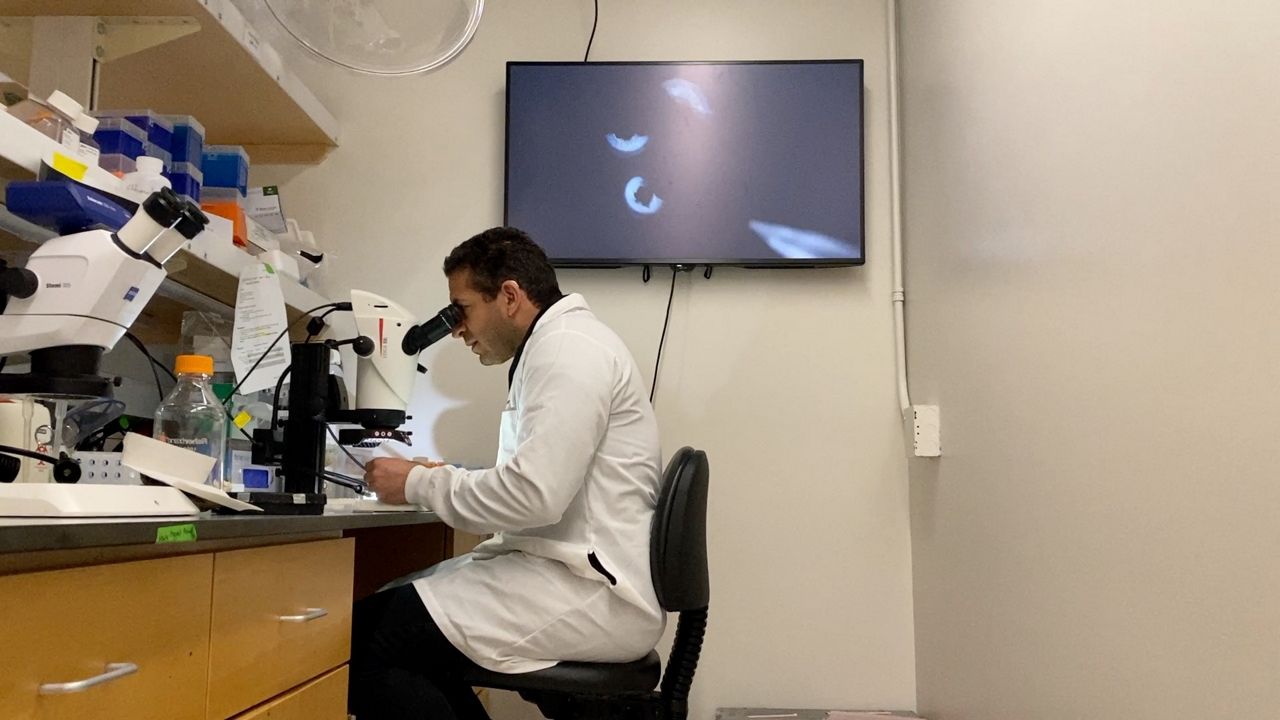
Exploring the mechanisms of the cochlea — the hearing organ in the inner ear — is a fascinating puzzle for Uri Manor, a cell biologist at UC San Diego.
“How did nature do this? It just made this perfect little spiral that has all these chemical and physical properties that allow sound to be converted into electricity, that then goes to the brain,” Manor said. “It’s absolutely amazing.”
Manor was born with severe-to-profound hearing loss but says millions of people will develop age-related hearing loss, which can be a risk factor in developing dementia.
“And that is what hearing loss does to you. It isolates you,” he said. “And that can have tremendous knock-on psychological and physiological effects.”
Manor has been researching if psychedelics could unlock a new way to treat hearing loss. For the first time, he and his team have discovered that psychedelics stimulate the growth of synapses — the connections between neurons — in the cochlea of mice.
“I would describe it probably as the most exciting of my scientific career,” Manor said. “At least at this point, which looks quite promising for treating age-related hearing loss, it is really gratifying. I hope it pans out, we haven’t proven that, we have a lot more work to do but the fact that we can regenerate these synapses gives us some hope that there might be a way to do that; so I’m really excited about that.”
A major drawback to using psychedelics in treatment is their strong hallucinogenic effect. To combat this, Manor collaborated with David Olson, a chemical neuroscientist at UC Davis and the director of the Institute for Psychedelics and Neurotherapeutics. He created a variety of non-hallucinogenic psychedelics.
“The way I like to describe this, it’s like we did a molecular tire rotation,” Olson said. “We developed a non-hallucinogenic analog of LSD, by just swapping two atoms. We took two atoms, and we switched their positions, and we created something that had improved safety profile compared to LSD.”
With other recent research findings, Olson says this new compound promotes neuroplasticity in the brain, which could hold enormous potential for treating a wide variety of neuropsychiatric diseases like depression and anxiety, and addiction and schizophrenia, where psychedelics can’t be prescribed for safety reasons.
“It’s important to remember that while psychedelics might have therapeutic potential, they were never engineered to be optimized neurotherapeutics; and so what we’ve done is use medicinal chemistry to kind of tweak their structures to make them better versions of themselves,” he said. “I hope that 20, 30 years from now, I can look back on my career and say that we did something to really change the paradigm for how mental health conditions are treated in this country.”
Manor believes the cochlea is the proverbial canary in the coal mine, serving as an early sign of neurodegeneration in the brain. He hopes their research can help give people a better way to age in the future.
“Even if you don’t experience it yet, hearing loss will probably become a very serious problem for you at some point,” he said. “So I’m really excited to try to help solve that problem.”
The scientists say they will need to continue to explore these avenues, and psychedelic compounds may one day offer a promising solution for those suffering from hearing loss, with a potential impact on a wide array of neurodegenerative diseases.
link